

Ohio law requires all healthcare providers to administer blood lead tests to children at ages 1 and 2, or up to age 6 if no previous test has been completed based on the following criteria: the child is on Medicaid, lives in a high-risk ZIP code, or has certain other risk factors. The Ohio Department of Health (ODH) offers a range of information and resources here about childhood lead poisoning for healthcare providers, including a summary of Ohio’s child lead testing requirements, medical management recommendations for children receiving blood lead tests, prenatal risk assessment for lead, a lead poisoning desk reference guide, and identification and management of lead exposure in pregnant and lactating women.

What is lead poisoning and who is at risk?

There is no safe amount of lead in the body, and no safe level of lead in a child’s blood. The Centers for Disease Control and Prevention (CDC) considers a blood lead level above 3.5 ug/dl to be high. Lead is most harmful to children under six because their bodies absorb it easily. It can also be dangerous to a baby during pregnancy. Even low levels of lead can cause permanent problems that last a lifetime, such as learning and behavior issues, lower IQ, attention disorders, and impaired hearing and growth. This happens because lead replaces important minerals like iron and calcium, affecting many parts of the body, especially the brain and nervous system. At very high levels, lead poisoning can lead to seizures, coma, and death.  

Where is lead found?

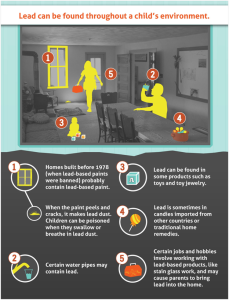
The most common cause of exposure in Ohio is from chipping lead based paint that results in lead dust.

Lead can be found in various items including:

  • Cosmetics containing lead
  • Foods containing lead
  • Hobbies that use lead-based materials
  • Occupations that involve exposure to lead
  • Soil contaminated with lead
  • Toys containing lead such as lead-based paint
  • Water with elevated lead levels

More items can be found here.

Ways to Prevent Lead Poisoning

  • Routinely wash your child’s hands, toys, bottles, and any items that your child frequently puts in their mouth.
  • Regularly clean floors, windowsills, and dust places with wet mops or wet cloths to pick up dust.
  • Look out for peeling paint in houses built before 1978 (when lead was banned in house paint). If you rent your home, report it to your landlord so that repairs can get made (and call code enforcement or a legal aid society if there is no response). If you own your home, repair it safely. To find out more about repairing peeling paint safely, see our Housing Resources page.
  • Use cold tap water rather than hot water when drinking and cooking and let the water run for a few minutes before use.
  • Avoid certain products from other countries, such as health remedies, eye cosmetics (e.g. kohl, kajal, surma), candies, spices, snack foods, clay pots and dishes, painted toys, and children’s jewelry. These and other items may contain high levels of lead.
  • Take your shoes off before entering your home.
  • If any household member works construction or other places that may involve lead, remove clothing before entering the home and wash them separately.
  • Be careful during renovations. Keep your child away from renovation or maintenance work that disturbs paint, and make sure no paint chips or dust remain in the work area before your child enters. If you hire someone to conduct renovation, repairs, or painting in a home built before 1978, make sure that they are certified by the Environmental Protection Agency to perform lead work.
  • Get professional help with screening your home for hazards and making repairs. A lead risk assessment will tell you if you have hard-to-find hazards such as lead dust, lead in bare soil, or lead in your water to prioritize any repairs you can have done. A lead-based paint inspection will tell you where the lead-based paint is in your home so you know the places (such as windows, doors, trim, porches, and other locations) to maintain and avoid disturbing. An abatement contractor knows how to eliminate hazards identified by either type of evaluation. See our Lead Licensure Program page for more information on finding a local professional.

If you have concerns related to lead, call the Ohio Department of Health Hotline, 1-877-532-3723.

Page last updated: May 28, 2026